Steve Crane of Business Link Japan

LATEST NEWS ............... STEVE CRANE AWARDED 'PERSON OF THE YEAR' AT THE BRITISH BUSINESS AWARDS IN JAPAN ...............................
Showing posts with label environmental. Show all posts

8 Feb 2011

Feb 8th - FT: Panasonic's Smart Fridges Light The Way

Panasonic's latest refrigerators, in addition to keeping food cool and making ice, use a light sensor to scan their owners' kitchens.

If these determine that it is night-time and no one is likely to open the doors for a few hours, they power down a bit to save on electricity.

Smart fridges are just one way that the Japanese electronics group is "greening" its business. In a corner of the same huge white-goods factory in which it makes its intelligent refrigerators, workers install circuitry into hydrogen fuel cells destined for Japanese homes.
The boxy machines will heat water and generate electricity with minimal emissions of carbon dioxide. At Y2.5m ($30,000) before government subsidies, they are far from cheap but Panasonic says that buyers can cut Y50,000-Y60,000 from annual utility bills as they help prevent global warming.
Toshiki Shimizu, the executive in charge, has big ambitions for what is still an experimental business. Panasonic has sold about 5,000 residential fuel cell systems since 2009 through local natural-gas utilities. But in a few years, he says, the company aims to expand the business to a scale "equal to refrigerators, air conditioners and other home appliances".
The fuel cells and smart-fridges illustrate a strategic shift among Japanese technology companies towards "green innovation".
It is a change driven in part by necessity, as lower-cost South Korean, Taiwanese and Chinese groups lure customers away from Japanese televisions and video players.
But companies also sense an opportunity, with rising energy prices and tougher pollution laws likely to increase demand for clean technology.
Japan's government has designated the sector as one of five strategic growth areas that it hopes will create 2.6m jobs and add Y149,000bn to manufacturing output by 2020.
Panasonic is aiming to more than triple revenues from clean technology to Y3,000bn by 2018.
Many other companies are also going green. Nissan and Mitsubishi Motors have begun selling battery-driven electric vehicles, building on a market for low-emission cars pioneered by Toyota's Prius petrol-electric hybrid.
Sharp and Kyocera are sharply expanding solar-panel production, while Sanyo, almost bankrupt a few years ago, has re-emerged as the world's largest maker of rechargeable batteries.
In all, three in 10 Japanese manufacturing companies are looking to enter the market for clean technology or increase their presence there, according to a survey by the industry ministry.
The bet on green technology is not a sure thing. Some analysts question whether returns will ever match those that are being lost in consumer electronics.
Much of the green sector depends on subsidies - a big risk, as rising government debt loads draw budget planners' attention from climate change to the risk of a bond market revolt.
And Japan is not the only country targeting the green market. China's solar-panel makers have soared past Japan's in production volumes since Beijing designated the technology a priority half a decade ago.
China is also investing heavily in wind power and encouraging its carmakers to develop their own electric vehicles.
Even so, Japanese executives are betting that, because many green technologies are still in their infancy, their companies have an advantage: there is plenty of scope for the kind of painstaking improvement in materials, design and manufacturing at which Japanese groups traditionally excel.
"If you look at solar panels, for example, energy conversion rates are still low," says Toshihiko Omote, deputy chief technology officer at Nitto Denko, a maker of filters, adhesives and optical films.
"It's important to look for 'no-limit' areas where it still matters when you set a world record for performance."

7 Feb 2011

Feb 7th - Itochu Forms Holding Firm To Promote Solar Power Business In USA

Itochu Corp. on Tuesday created a holding company in California, which it claims to be the largest marketer of solar power generation systems in the United States, through management integration of its two local subsidiaries, the major trading house said.

The new firm, SolarNet Holdings LLC, aims to better compete against Chinese solar panel makers to tap rapidly growing U.S. demand for solar energy.
The holding company now owns all shares in Itochu's two subsidiaries -- SolarNet LLC and Solar Depot LLC, both based in California.
SolarNet operates DC Power Systems, a wholesale distributor of renewable energy products, and solar energy systems integrator Stellar Energy GP Inc.
Solar Depot is a wholesale distributor and systems integrator of solar electric and thermal systems.

27 Jan 2011

Jan 27th - NTT Group To Help Firms Embrace Electric Vehicles

The Nippon Telegraph and Telephone Corp. group plans to assist businesses in adopting electric vehicles by providing the infrastructure and services necessary to do so.

To commercialize this business within two years, the group will launch a car-sharing trial in March. The car-sharing service will combine such technology as NTT Facilities Inc.'s rapid chargers with NTT Data Corp.'s  authentication systems.

The car-sharing program will use rapid chargers installed at NTT buildings.
Charging stations will be installed at two NTT group buildings. Mitsubishi Motors Corp.'s  i-MiEV and Nissan Motor Co.'s  Leaf electric cars will be deployed.
The EVs will be fitted with telecommunications equipment using the cellular phone lines of NTT DoCoMo Inc.  GPS technology will allow the EVs' locations and other details to be checked online.
This will let the group offer a bundle of services, including call centers to help operate chargers and assist with breakdowns, driver recognition technology using telecommunications networks, and charger infrastructure.
Users can borrow the EVs when they want on an hourly basis. The cost is targeted at around 800 yen per hour, which is on a par with current car-sharing prices.
Based on the trial results, the NTT group will commercialize the leasing of EVs and chargers to businesses, as well as market support services to outside firms.
EVs are increasingly being adopted by local governments, but have yet to spread widely among businesses. Companies say that initial costs, charging infrastructure and maintenance are an obstacle for using EVs for business purposes.

20 Jan 2011

Jan 20th - Toyota, Honda, Nissan, Carmakers Focus On Hybrids To Rev Domestic Sales

Leading Japanese automakers are seeking to expand their hybrid vehicle lineups to boost their slumping domestic sales following the end of a government program subsidizing purchases of cars deemed environmentally friendly.


Toyota-affiliated dealerships in central Tokyo continued to face weak demand in early January.
The end of the subsidy program in early September hurt domestic car sales, sending them down more than 20% year on year during the October-December quarter. Owing to the yen's strength, Japanese carmakers were unable to boost exports to offset the weak domestic sales.
Many car dealers and other industry insiders initially predicted sales would rebound from the slump in three or so months following the program's termination. But evidently this prediction was too optimistic.
And there have been no signs of recovery in the new year, either.
Incentives ineffective
Some dealerships have sought to rev up their sales by offering such incentives as free navigation systems and low-interest loans. But these incentives have been nowhere near as effective as hoped.

"The situation is beginning to get quite serious," said a representative of the Japan Automobile Dealers Association.
The government subsidy program boosted domestic sales 7.5% on the year to 4.95 million vehicles last year, the first annual gain in six years. But, for the second straight year, the sales again failed to hit 5 million units.
The Japan Automobile Manufacturers Association forecasts Japanese auto demand will weaken another 10% or so to 4.46 million units this year. That is below even the 4.6 million vehicles sold in 2009, when fallout from the global financial crisis sharply dampened demand.
The forecast level would be less than 60% of the peak demand reached in 1990.
Toyota Motor Corp. aims for sales of 1.3 million units in Japan this year, down 17% on the year. It expects a bigger fall than the industry average because its product lineup is skewed toward regular passenger cars and other vehicles, a class of vehicles larger than minicars that owners must register. Demand for the bigger cars has fallen much more sharply than demand for minicars.
Even in this tough environment, Toyota aims for domestic output of 3.1 million vehicles this year, limiting a year-on-year fall to 5%. It hopes to achieve the target by increasing exports from last year's level.
But President Akio Toyoda conceded the company will likely face such strong headwinds as the yen's sustained appreciation.
"The yen's current strength is imposing such a heavy financial burden that no company can bear it for long," he said.
Hybrid hopes
Against this backdrop, Toyota is scheduled to add a station wagon model to its lineup of Prius hybrid vehicles as early as this summer.
Similarly, Honda Motor Co. will soon broaden its hybrid car offerings, adding station wagon and minivan models, so that hybrid sales will account for more than 20% of its total sales in Japan next fiscal year.
The rolling out of new hybrid models -- a type of car for which tax breaks are still given through spring 2012 under another government program -- is intended to boost slumping domestic sales.
It also points to the fact that along with fuel-efficient small cars, hybrids have become strong sellers in an otherwise weak domestic market.

19 Jan 2011

19th Jan - Sumitomo Forestry, Toshiba Join In Smart-Home Energy Systems

Sumitomo Forestry Co. and Toshiba Corp.  will co-develop home energy management systems (HEMS) for smart homes.

The systems use information technology to control and manage power to the home and optimize electricity consumption.
Sumitomo Forestry, a leading builder of single-family homes, has been procuring HEMS systems from Toshiba whenever a customer requested the technology. Toshiba approached Sumitomo Forestry with the joint-development proposal, aiming to secure clients for its HEMS products.
Through the tie-up, Sumitomo Forestry will tailor HEMS to include specifications optimized for the home designs it offers. Starting later this year, it will begin marketing smart homes that feature power control systems, storage batteries and other products procured from Toshiba.
As a first step, the company will offer smart homes with systems that feature a screen on which the owner can monitor such factors as the electricity output from solar panels, the level of power stored in the household batteries and overall energy consumption.
In the future, the HEMS features will be enhanced to include such functions as automatic control over air conditioners and other appliances based on indoor and outdoor temperatures and humidity. It will also provide support for charging electric vehicles and plug-in hybrids.
The tie-up between Sumitomo Forestry and Toshiba is just the latest in a string of HEMS partnerships between homebuilders and electrical machinery makers.

19th Jan - Tamura Improves Reflective Material For Solar Cells, LED Lights

Tamura Corp. has developed an improved type of white reflective material for solar panels and LED lights that features around 10% higher reflectivity than its current product.

By better reflecting back the infrared light and the parts of the visible spectrum that are normally lost because they pass through, this material can help solar panels generate more power and make LED lights brighter.

The new reflective material is a type of white liquid made from a mixture of resin and pigments. Tamura found a way to reduce the relative amount of resin without sacrificing strength so that the liquid could contain relatively more light-reflecting white pigment. The new formulation can reflect 90% of infrared and visible light, compared with the 80-85% the firm's current product.
In addition, the new material helps simplify the manufacturing process for solar panels. Its insulating properties eliminate the need for an insulator between the reflective sheets and the circuits for collecting generated power.
Solar panels and LED lights are typically use white reflective sheets to bounce back lost light. Tamura's reflective material is a liquid, so it can be applied using printing and spraying to the glass substrates under solar panels and the substrates of LED lights.
Tamura will ship samples of the new material next month to makers of solar cells and LED lighting. It plans to begin volume production this April, aiming for sales of around 2 billion yen in fiscal 2013.

24 Dec 2010

Dec 24th - Fuji Electric and General Electric To Team Up On Smart Meters

Fuji Electric Holdings Co. said Friday it will set up a joint venture with General Electric Co. of the U.S. on Feb. 1 to make next-generation smart meters.

The date was officially set after a longer-than-expected antitrust screening process in China.
The venture for network-capable electricity meters had initially planned to get under way in October.

30 Nov 2010

Nov 30th - Sumitomo To Invest In French Solar Power Project

Sumitomo Corp. plans to take a stake in photovoltaic facilities now under construction in southern France and slated to come onstream next spring.

This is the first time that a Japanese company participates in a French solar power project.
Eco Delta Developpement, a French energy resources firm based in Marseilles, is building 30,000kw of solar plant facilities for roughly 14 billion yen in Les Mees, Alpes-de-Haute-Provence.
Sumitomo will obtain a 49.9% stake in the management company already established to oversee the plant operations. The Japanese trading house will also shoulder half of the project's costs. The facilities will supply power to a French power utility for 20 years, ensuring stable earnings, according to Sumitomo.
The French government plans to increase its domestic solar power generation capacity from roughly 130,000kw to 5.4 million kilowatts in 2020. With France and other European countries expected to pursue solar power projects, Sumitomo aims to accelerate its investment in the region.

2 Nov 2010

Nov 2nd - Mitsubishi Chemical Corporation - "Production of Electrolyte for Li-ion Batteries to Start in the UK and the US"

Mitsubishi Chemical Corporation ("MCC"; Head office: Minato-ku, Tokyo; President: Yoshimitsu Kobayashi) has decided to establish new companies to manufacture and sell electrolyte for Li-ion batteries (LiBs) in the UK and the US.

Both new operations will be located on the premises of production sites of Lucite International Group Limited (Head office: Southampton, the UK; CEO: Ian R. Lambert) that is the wholly-owned subsidiary of Mitsubishi Rayon Co., Ltd. (Head office: Minato-ku, Tokyo; President: Masanao Kambara).

MCC, as the only company in the world to provide all four key LiB materials - electrolyte, anode, cathode, and separator, will further develop the LiB materials business by offering optimal material solutions meeting customer needs and being committed to consistent quality and global supply.


1. Outline of the New Company in the UK
 •NameTBD
 •LocationBillingham, Stockton-on-Tees, the UK
 •Capital8.3 million GBP (Approx. 1.1 billion JPY) - MCC 100% -
 •Production Capacity10,000 MT/Year
 •Capital ExpenditureApprox. 2.5 billion JPY (Under examination)
 •Commercial OperationScheduled to begin in the autumn of 2011

2. Outline of the New Company in the US
 •NameTBD
 •LocationMemphis, Tennessee, the US
 •Capital13.1 million USD (Approx. 1.1 billion JPY) - MCC 100% -
 •Production Capacity10,000 MT/Year
 •Capital ExpenditureApprox. 2.5 billion JPY (Under examination)
 •Commercial OperationScheduled to begin in the summer of 2012

3. MCC's Capacity Expansion Plan of the Four Key LiB Materials
(Unit: "m2/Year" for separator, "MT/Year" for the others)
 Production
Capacity,
Location
Capacity Expansion Plan,
Location,
Commencement of
Commercial Operation
Target Capacity
in 2015
Expansion
Area
Electrolyte8,500,
Yokkaichi
+5,000,
Yokkaichi,
Feb. 2012

+10,000,
the UK,
Autumn 2011

+10,000,
the US,
Summer 2012
50,000Japan and
Overseas
Anode3,000
Sakaide
+2,000,
Sakaide,
Dec. 2010

+2,000,
Sakaide,
May 2011

+4,000,
China,
Mar. 2012
35,000Japan and
Overseas
Cathode600
Mizushima
+1,600,
Mizushima,
Oct. 2010
15,000Japan
Separator12 million,
Nagahama,
Mitsubishi Plastics, Inc.
 72 millionJapan
 
Expected Sales of Four Materials
in Fiscal 2010: 17 billion JPY
 Expected Sales of Four Materials
in Fiscal 2015: 80 billion JPY

Locations of the New Companies
 
Lucite, the UK Lucite, the US

21 Oct 2010

Oct 21st - Panasonic aiming for $35 billion green business by 2018

Panasonic Corp. has announced Green Plan 2018, a multifaceted environmental action plan to be executed by 2018, the year in which it will celebrate its 100th anniversary. By implementing the plan, Panasonic will establish a green energy business with 3 trillion yen (US$ 35billion*) in sales, declared Fumio Ohtsubo, president of Panasonic.
* Original figures are in Japanese yen. The exchange rate is roughly US$1=85 yen.

101006-panasonic-ohtsubo.JPG
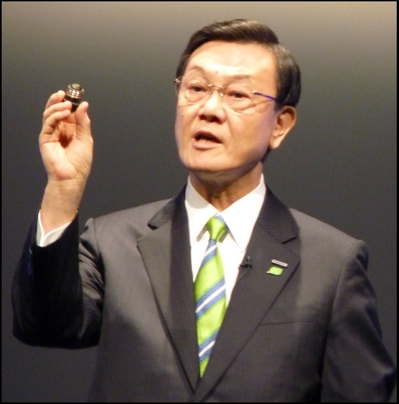
Fumio Ohtsubo, president of Panasonic, shows the company's very first product, a light bulb socket adaptor—the seed from which the consumer electronics giant grew.

Green Plan 2018 calls for a 120-million-ton reduction in CO2 emissions in the final year of the plan, derived from operations and power-saving products, compared with Panasonic's simulation of what CO2 emissions would be if the company had adopted a business-as-usual approach to emissions from 2005 onward.
The plan also includes actions to improve Panasonic's environmental performance with respect to resource recycling, water consumption, the impact of chemical substances, and conservation of biodiversity. The worthy environmental philosophy Panasonic advocates is only half the story: the red meat is a tough-minded business plan that aims to expand sales of green-related businesses bundled as the "energy systems business" to 3 trillion yen by 2018, which will account for about 30% of Panasonic's sales target for that year.
"I believe what sets Panasonic apart from other global contenders is our unique capability to propose energy management solutions for the entire home, building and town," said Fumio Ohtsubo, president of Panasonic.
As if to highlight this capability, at the CEATEC show now underway at Makuhari, Panasonic is demonstrating its SEG (Smart Energy Gateway) system for smart management of power generation, storage and consumption. The company is positioning SEG at the heart of its budding green business.
Right on cue, completion of the absorption of Sanyo Electric and Panasonic Electric Works by a TOB that closed on October 6 allows Panasonic to secure technologies and products it needs for developing a business based on its "entire home" concept in Japan.
"For the Japanese market, we can grow our business using Sanyo and Panasonic Electric Work's platforms. For global development, it is important to select the right partners," said Ohtsubo.
Panasonic has already started field testing a home energy management system linked to a smart grid in a collaborative project with Danish energy company SEAS-NVE.

19 Oct 2010

Oct 19th - Eco-Car Batteries Driving Tectonic Shift. Toyota, Sanyo, Panasonic

As the growing popularity of hybrid and electric vehicles makes batteries a crucial car component, the need for reliable supplies of high-performance batteries has been fueling reorganizations of the automobile, materials and electronics industries.

Sanyo's lithium ion battery plant in Hyogo Prefecture.
Such tectonic shifts were recently illustrated by Toyota Motor Corp.'s decision to use Sanyo Electric Co.'s lithium ion batteries in its strategic Prius minivan, a hybrid due for launch early next year.
The move marks a major departure from the leading carmaker's past practice. Toyota has fitted its Prius lineup with nickel-metal hydride batteries ever since the first generation in 1997.
After having developed and produced hybrid-car batteries with Panasonic Corp. it was a big decision for Toyota to turn to an outsider for the key component -- even considering that Sanyo will become a 100% unit of Panasonic next spring. But switching to lithium ion batteries will bring benefits that outweigh the risk, since they are more powerful and smaller -- enabling Toyota to bolster the fuel economy and interior sizes of its hybrid vehicles.
Today, Sanyo is the global leader in lithium ion batteries. In the green-car battery category, the company now counts Suzuki Motor Corp, Ford Motor Co. and Volkswagen AG among its customers.
Toyota, however, had set its sights on Sanyo much earlier. Back around 2005, when Sanyo was facing financial difficulty, Toyota asked the firm for a factory tour, with the aim of assessing the company's technologies.
Looking back, a Toyota executive confides, "We very much wanted Sanyo's battery technologies." After careful analysis, the automaker concluded that "Sanyo is valuable enough to warrant an acquisition," the executive says.
Even though the management turmoil at Sanyo back then ultimately kept Toyota from making an overture, Sanyo's value as an acquisition target remained intact.
In fact, Panasonic is about to fully acquire Sanyo through a tender offer. Panasonic will have spent over 800 billion yen on the purchase by the time it converts Sanyo into a wholly owned unit.
Panasonic reckons the investment will pay off. Sanyo is expected to play a key role in Panasonic's plans to lift sales in the environment and energy fields roughly sixfold to a whopping 3 trillion yen by fiscal 2018. Toward this goal, the two companies aim to work together to ensure that they will secure the leading position in the increasingly important market for hybrid- and electric-vehicle batteries.

Oct 19th - Japan Smart-Grid Project May Help Spawn New Export Industry

The smart grid that Okinawa Electric Power has begun operating on the island of Miyako-jima holds tremendous value for Japanese companies because it can verify technologies they can apply to develop businesses overseas.
The government is trying to nurture smart-grid technologies as a new export industry. In fact, the pilot smart grid on Miyako-jima is a steppingstone to verification projects in the West, in which the Japanese government will help domestic companies participate.
The load-leveling control system for Miyako-jima's grid was developed by Toshiba Corp. while the sodium-sulfer storage battery complex was developed by NGK Insulators Ltd.  and the panels for the solar power system were developed by Sharp Corp.  Kyocera Corp. and Kaneka Corp.
Because nations have different standards and specifications for their power infrastructures, Japanese companies have focused their smart-grid efforts on the domestic market. But this has raised concerns that the firms may miss opportunities in what is expected to be the rapid installation of next-generation power infrastructure in Europe, which is introducing wind power and other renewable energy sources, and in the U.S. and newly emerging economies, where demand for electricity continues to expand.
The Miyako-jima project is a way for Japanese companies to test their smart-grid technologies domestically. But the Japanese government is also supporting their efforts to expand the business abroad.
For example, it will support the construction of a test facility in the U.S. state of New Mexico, where 19 Japanese firms will participate starting in fiscal 2011. And it will back the participation of Japanese firms in verification experiments to be conducted in Spain and France.

Oct 19th - Smart Grid Goes Live On Okinawa Island (Toshiba)

-In a significant first for Japan, Okinawa Electric Power Co. has begun operating a smart grid to control the supply of renewable-energy-derived electricity for the 55,000-strong population of the remote Okinawa Prefecture island Miyako-jima.

Okinawa Electric operates a large solar power facility.
The launch on the island is important because it marks the nation's first autonomous system of smart-grid infrastructure that uses massive storage batteries to stably supply electricity by offsetting wild fluctuations in the production of solar and wind power.
The infrastructure Okinawa Electric is operating links the existing power grid to a 4mw solar power plant and a sodium sulfur (NaS) battery complex capable of storing 4mw of power. Some lithium ion batteries have also been installed.
The utility spent 6.15 billion yen on the infrastructure, two-thirds of which was subsidized by the central government.
Toshiba Corp.  manufactured the load-leveling control system and other major components of the grid. The storage batteries were supplied by NGK Insulators Ltd.
In addition to controlling the supply of power to the grid from the new solar power plant, the system also controls power from existing 4.2mw wind farms situated on Miyako-jima.
Up until now, Okinawa Electric has leveled the load to the grid from the wind farms by increasing and decreasing the fuel burned in a thermal power plant. By switching to the use of storage batteries and other smart-grid technologies, the company will be able to increase its use of renewable energy resources on the island without increased dependence on the thermal power plant.
The government plans to subsidize the installation of solar power systems in Japan and achieve a more than 10-fold increase in generation capacity to 28,000mw in 2020. Smart-grid technologies are essential if this renewable-energy-derived electricity is to be supplied in a stable way to the national power grid.

18 Oct 2010

18th Oct - New Electric Vehicle sharing service from Orix Auto and Nihon Unisys

Coat-tailing on the twin trends of shared rental cars and  electric vehicles (EV) going mainstream, Orix Auto and Nihon Unisys have formed a group to start an EV car sharing service in Osaka. The new service will start with 12 Nissan Leaf cars this year, and expand to at least 50 units by 2013. Rental rates have not yet been decided, but in other areas where car-sharing is popular, the rates typically run around JPY6,000/month.

11 Oct 2010

11th Oct - Toyota Hopes Energy Efficiency will 'Light Up' it's Housing Operations

Toyota Motor Corp. is looking to beef up its home-building business by focusing on energy efficiency.


The centerpiece of its strategy is its new energy management system, which lets residents better control their electricity consumption, in their houses and when charging electric cars.
At a press conference on Tuesday, Toyota Senior Managing Director Nobuyuki Kodaira unveiled the energy management system, saying it was Toyota's answer to the problem of global warming. The carmaker is "responding to the environmental challenge by linking Toyota's car- and house-making businesses," he said.
The system, called Toyota Smart Center, tracks home power consumption, including any plug-in hybrid or electric cars being recharged. The system can help households reduce their carbon dioxide emissions by 75%, according to a Toyota executive. The company plans to bring the system to market in 2012.
Japan's largest carmaker is hoping its green technologies boost the sales of Toyota Housing Corp., its home-building subsidiary.
All in the family
Toyota Housing President Senta Morioka, who was also at Tuesday's press conference, said the energy management technology will help his company compete with bigger rivals.
Toyota recently integrated its home building operations within Toyota Housing. By bringing Toyota's housing manufacturing, marketing and technology development under one roof, Toyota Housing has become a full-fledged home builder.

Toyota unveils its newly developed household energy management system, which is expected to hit the market in 2012.
Toyota Housing has also become the leading shareholder of Misawa Homes Co. holding a 27.8% stake in the firm.
Toyota's housing business is a legacy of the founding family, and the automaker's effort to bolster the unit has shifted into a higher gear since Akio Toyoda, a member of the family, took the helm last year.
The business dates back to the era of Toyoda's grandfather, Kiichiro, who virtually founded the automaker and began building concrete houses in a quest to provide fire-resistant housing to Japanese home-buyers.
In 1975, Shoichiro Toyoda, Akio's father, led Toyota's entry into the home-building market by setting up a housing division within the company.
Looking for a spark
The new age of smart grids and electric cars offers Toyota an opportunity to find synergies between its vehicle and home-building businesses. The commitment of the Toyota group to the effort is underscored by the stakes that nine group companies, including Denso Corp, Toyota Industries Corp and Aisin Seiki Co, have acquired in Toyota Housing. On Oct. 1, they bought a combined 12% of the unit.
After many years of struggling to increase its presence in the market, Toyota Housing definitely needs the support.
With annual sales of slightly more than 4,000 detached houses, Toyota Housing is not among the biggest players in the industry. Sekisui House Ltd, the nation's No. 1 home-builder, sells 15,000 units per year.
The outlook for the market is harsh, with new housing starts in the year through March at a 45-year low. Fewer children and an aging population spell trouble for the industry.
Toyota Housing President Morioka believes the reorganization will speed up the company's decision-making. But the move to combine manufacturing and marketing is hardly revolutionary.
Rivals appear unconcerned about a challenge from Toyota. Toyota Housing certainly has ample management talent, but the firm is not yet a formidable competitor in terms of sales muscle or product quality, said a senior executive at a major home-builder.
In order to grab business from bigger rivals, Toyota Housing is trying to emulate Misawa Homes. Toyota Housing Chairman Teiji Tachibana, who also serves as Misawa's chairman, is pushing the unit's executives to gain marketing and technological expertise from Misawa. Backed by the firepower of the Toyota group, Toyota Housing has a shot at becoming a serious challenger to the market leaders, analysts say.

10th Oct - Panasonic and 32 other Japanese companies to Share Biodiversity Standards

Panasonic Corp and 32 other companies plan to adopt a shared set of guidelines for assessing the impact of their factories and office buildings on local ecosystems.

This effort, part of a growing movement towards conservation in the private sector, comes amid rising social awareness of how companies treat the environment.
The Japan Business Initiative for Conservation and Sustainable Use of Biodiversity includes architectural firm Takenaka Corp., Mitsui Sumitomo Insurance Co., Kao Corp, Ricoh Co. and Teijin Ltd.. It aims to eventually include all of the business world.
The organization has created an 18-category assessment method that assigns corporate facilities a score of up to 100 points. An office or factory can get the full score of 10 points in the category of green space, for example, if at least 40% of the property is covered by vegetation. Other categories assess whether facilities are using local varieties of plants or the right mixture of trees and shrubs.
Panasonic's facilities received 20-something to upwards of 50 points when the standards were applied on a trial basis. The company says the assessment uncovered many areas for improvement, including the slopes of the banks for its artificial ponds.
In addition to taking their own steps to protect the environment, a growing number of companies are pressuring client firms to do the same.
Japan will from Monday host a series of meetings in Nagoya about the Convention on Biological Diversity. Some 8,000 participants from 193 countries and territories will gather to set goals for protecting wildlife and a protocol for distributing profits from plant- and animal-derived products. Parties to the treaty will meet from Oct. 18 to seek a consensus on the goals and the protocol. Prime Minister Naoto Kan is scheduled to speak on the first day of a ministerial conference for treaty states starting Oct. 27.
The world loses about 40,000 varieties of plants and animals through extinction every year, by some estimates. Without effective steps to protect the ecosystems in the next decade, the damage could become irreparable, scientists say.